Are social scoring systems a threat to democracies?
China’s social scoring system has sparked fears of similar developments elsewhere. A Swiss team is currently trying to find out how democracies can prevent social scoring.
A society where you are rewarded for parking properly or living healthily may sound like a dream to some, and a nightmare to others. Even a bonus system that only rewards without punishing could push people with low scores to the edge.
Pilot projects in China and dystopian films have raised awareness of this issue, which goes by many names. Government critics call it state-led nudging while others use more benign terms such as social scoring, bonus schemes or social credit systems.
“China must not become our benchmark for what we want in Western European societies,” says Swiss scientist Johan Rochel. He is part of a team researching social scoring on behalf of the Swiss Foundation for Technology Assessment TA-Swiss which examines the opportunities and risks of new technologies. The results of the study will be published in 2026.
German bonus system
Back in 2020, a future study commissioned by the German Ministry of Research, Technology and SpaceExternal link created a scenario in which such a bonus system might take hold in Germany in the 2030s.
A bonus system could also boost Germany’s quality of life through a “data-driven optimisation of public services,” the study points out. The points system could serve policymakers as “a forecasting and steering tool to optimise the economy and implement targets”.
According to the study, social scoring in Germany’s representative democracy would need to be combined with direct democratic instruments like those used in Switzerland.
The study’s scenario outlines that a new “digital liquid democracy” would define the rules of such a system.
Supported by digital assistants, the German population would continuously adjust their behaviour to whatever is rewarded – be it decency, an eco-friendly lifestyle or abstaining from alcohol. Everyone should have a say in shaping the system that governs and rewards them.
The study outlines six scenarios for 2030 and highlights some drawbacks. The bonus system could potentially spark new conflicts as those who fall behind in points might struggle to catch up and become part of the group of people who are “permanently left behind”.
EU bans AI for social scoring
Since the study was published in 2020, the likelihood of such scenarios becoming reality has shrunk. In 2024, the European Union (EU) banned AI algorithms used for social scoring, however, there is no such ban in Switzerland yet.
Sinologist Adam Knight of Leiden University in the Netherlands welcomes the EU ban. For him it is a clear statement that social scoring is not compatible with European values.
From the EU’s perspective, social scoring jeopardises privacy, equality and due process as it reduces people to algorithmic profiles. Knight warns that the true danger lies not just in surveillance, but also in “automated discrimination”.
More than 50 laws for social credit system in China
In China, the social credit system has now been implemented nationwide. “In the last few years, China’s social credit system has quietly evolved from local experiments and sensation-seeking pilot projects to legal standardisation and bureaucratic implementation,” Knight explains.
The China expert believes that 2022 marked a turning point in the development. “Since then, the authorities have focussed on embedding social credit mechanisms into national regulations, and now there are 50 laws that contain provisions related to social credits.”
Blacklists still exist, Knight says, but recent reforms have made it possible to “repair credit” and shift the focus more on rewards and rehabilitation. Pilot projects such as tracking alcohol consumption and training programmes have quietly been phased out. The system is now less about “moral disciplining” and more about economic development.
Instead of single scores, China now has an “enforcement infrastructure”. Based on data on “violations”, a “broad network of red flags” can now block access to loans, contracts, jobs or public services.
“What remains is a powerful data-based instrument to govern through visibility. If you break the rules, you will leave a trace,” explains Knight.
How does Switzerland’s debt register fit in?
But Knight points out that “algorithmic profiling“ already exists in the EU which makes the ban raise questions about how such practices should be dealt with. The “logic to reward trust and punish risks” can also be found in many western countries,” he says.
Knight mentions platforms like Airbnb, Uber and Yelp as examples of credit bureaus where ratings and scores can have significant consequences. Yet, he says, similar systems also exist on the government side. “Take the Swiss debt register, for example. It publicly lists those who have not paid their fines or bills.” Since being listed can stop someone from finding a flat or even a job, the register is not so different from a blacklist in a social credit system.
For Knight, the key question is not whether the Swiss debt register is similar to the Chinese system, but rather how “data and behaviour patterns increasingly influence access to services worldwide, and which safeguards are in place to protect individual rights.”
How to spot social scoring?
Scientist Rochel says: “The challenge lies in recognising social scoring for what it truly is.” The TA-Swiss research project aims to tackle exactly that, namely how society should define social scoring and how to recognise it as such.
“Under EU guidelines on AI, social scoring is a banned application,” says Rochel. “However, we still need a clear definition of what it entails.” Rochel, who is also a lawyer and a philosopher, believes that upcoming legal cases will shed light on what falls under the EU ban.
But Rochel expects that oftentimes government bodies and private companies will not realise “whether they are using a social scoring system or something else.” He fears a lack of public debates and an “introduction [of the system] driven by a pilot project logic.”
Areas affecting the public’s wellbeing are especially delicate, Rochel says, citing a software that made headlines in Switzerland a few years ago. It allowed teachers to flag their students as potential terror treats. The website for this service has since been taken offlineExternal link.
Risk areas transport, environment, health
Beyond public security, Rochel sees transport, the environment and health as high-risk areas. He points at a proposal by Germany’s current chancellor Friedrich MerzExternal link, who once suggested offering a 10% health insurance discount to anyone willing to share their health data. At first glance, such proposals seem harmless, especially because they are voluntary. But Rochel warns that unlike a mandate or a ban, the term “voluntary” quickly loses its meaning when the social or financial cost of opting out becomes too high.
Merz’s proposal sparked debate and sharp criticism in early 2025, and to Rochel’s relief, the issue has already been discussed in the Swiss parliament. Public debates, he says, act as protection mechanism against the quiet introduction of such systems.
In 2020, parliamentarian Thomas Burgherr of the Swiss People’s Party submitted an inquiry asking how the Federal Council viewed “behavioural drivers and other “little” psychological tricks of behavioural economicsExternal link”, and how they aligned with democracy and rule of law. The Federal Council’s response suggested that the government sees nudges as an alternative to bans noting that “behavioural economic insights and methods (…) may play a role in certain areas.
The authors of Germany’s 2020 future study are now more sceptical about the effects of democratic mechanisms. Michael Astor says the idea behind combining the bonus system with direct democracy was to protect the system against misuse, mitigate the risk of social division and ensure the system could adapt to “changing societal needs”.
Astor appears to be more critical about the study’s scenario than when it was first published. “Given that many democracies are shifting towards the right, scepticism is growing towards ethnic, racist or otherwise motivated social control that such systems could enable.”
The anticipated “positive effect of participation” seems increasingly out of reach.
中国発「社会信用システム」、民主主義はどう向き合うか
政府が収集したデータで国民をランク付けする——中国で導入された「社会信用システム」は多くの国で懸念を呼んだ。良い行動へのインセンティブは本当に無害か。AI(人工知能)による人物評価はどこまで規制できるのか。民主主義の果たす役割とは。研究者たちはその答えを追い続けている。
by Benjamin von Wyl
https://www.swissinfo.ch/jpn/デジタル民主主義/中国発「社会信用システム」、民主主義はどう向き合うか/89578605
駐車マナーを守る。健康的に暮らす。そうした行動や生活態度に報奨(インセンティブ)を与える社会は、一部の人にとっては魅力的に映るかもしれない。だが、多くの人は問題だと感じる。罰則のない「ポイント制」であっても、そうした仕組みはポイントの低い人々を社会の隅に追いやる可能性があるからだ。
中国が試験的に導入した社会信用システムやディストピアを描いた映画が、こうした問題への関心を高めるきっかけとなった。このテーマは社会信用スコア、ソーシャル・スコアリング、インセンティブシステムなど、さまざまな言葉で表現されている。こうした制度を国家による巧妙な誘導だと警戒する人もいる。
「われわれ西側社会が目指すものを考えるときに、中国を基準とするべきではありません」。そう話すのは、スイスで社会信用システムなどを研究するプロジェクトのメンバー、ジョハン・ロシェル氏だ。このプロジェクトはスイス技術評価財団TA-Swissが実施しているもので、調査結果は2026年に公表される。
「慢性的な落ちこぼれ層」が生まれる社会?
ドイツでは2020年、連邦教育研究省(現研究技術宇宙省)の委託を受けた未来研究プロジェクトが、30年代のドイツ社会における6つの仮想シナリオを提示した。その1つが「ポイント制」を導入した社会で、以下のように考察されている。
ポイント制が定着したドイツでは、「データに基づいた公共サービスの最適化」のおかげで生活の質が向上している。政府は「経済活動の最適化や政策目標の達成を支援する予測・管理ツールとして」このシステムを活用している。
人々はAIアシスタントの助けを得て、どのような行動がポイントに値するのか確認し(礼儀正しさか?エコなライフスタイルか?禁酒か?)、逐次再設定していく。ただし、システムの構築や運用については、すべての人の関与が必須である。
新たに「デジタル・リキッド・デモクラシー」が、システムの「運用ルール」を定めることになる。リキッド・デモクラシーは「液体民主主義」とも呼ばれ、オンライン上のプラットフォームを利用して、一人ひとりが直接、あるいは他人に委任して間接的に意思決定に関与する仕組み(またはその概念)だ。
研究レポートは、間接民主制(議会制民主主義)を採るドイツでは、ポイント制の導入はスイスのような直接民主制の手法とセットで考えなくてはならない、と述べている。また、この制度は「新たな対立」を生み出す可能性が高いという欠点も指摘。ひとたびポイントで周囲に後れを取ると、その状態からほぼ抜け出せなくなり、「慢性的に落ちこぼれた層」に定着してしまうという。
AIによるスコア化、欧州は「ノー」
だが、2020年の研究報告以降、こうしたシナリオの実現可能性はむしろ低くなっている。欧州連合(EU)は24年、ソーシャル・スコアリング(AIが個人の社会的行動や性格の予測に基づいて、個人や集団を評価・分類すること、またはそのシステム)に使う目的でのアルゴリズム利用を禁止した。一方、スイスでは今のところ、こうした法規制は存在しない。
オランダ・ライデン大学の中国研究者、アダム・ナイト外部リンク氏はEUの規制を歓迎する。ソーシャル・スコアリングは欧州の価値観とは相容れないと、明確に示したことになるからだ。ソーシャル・スコアリングは人々を単なるデータやスコアとして扱うため、プライバシー、平等、適正な手続きという価値観を脅かす、というのがEUの見解だ。監視のみならず「AI差別」も警戒しなくてはならない、とナイト氏は話す。
違反行為のせいで公共サービスの利用に支障も?
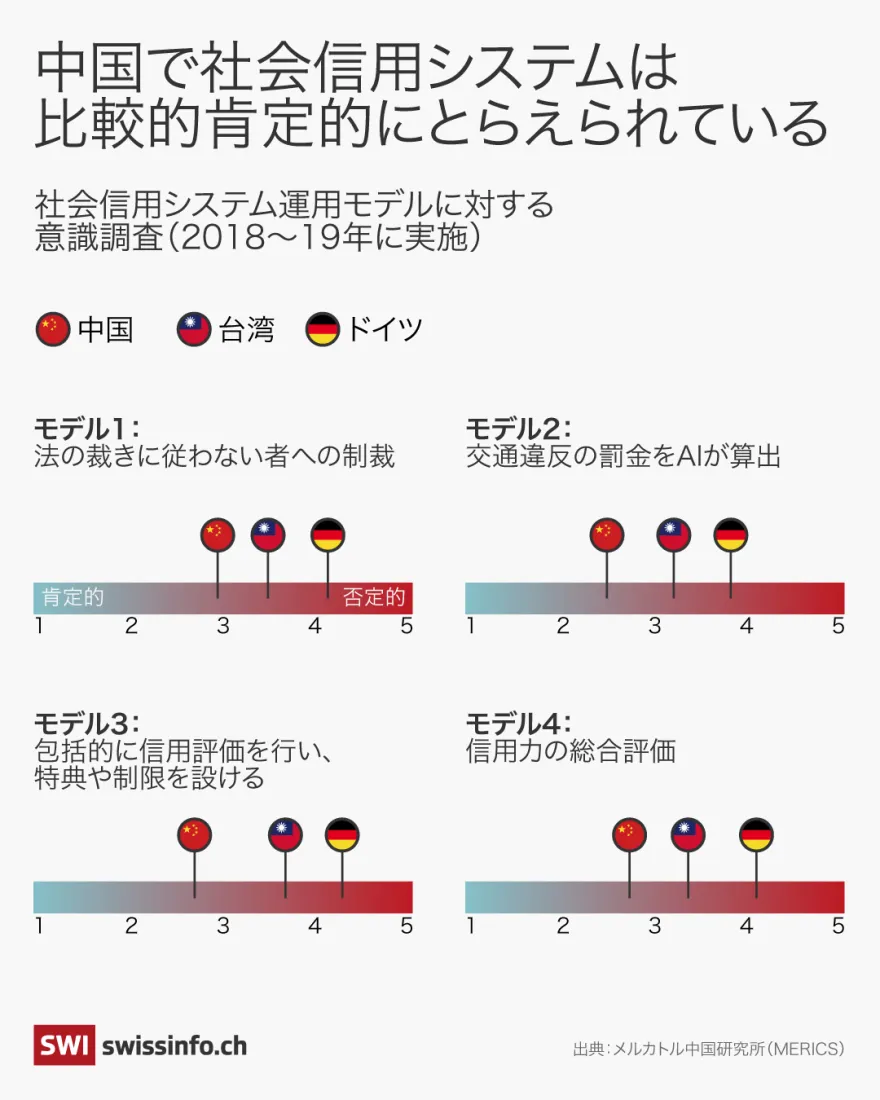
中国の社会信用スコアは今や、全国で確立されたシステムとなった。「地方での実験的な取り組みや話題性の高い試験プロジェクトとして始まりましたが、ここ数年でひそかに法整備が進み、中央政府主導の制度へと変化を遂げました」とナイト氏は説明する。
ナイト氏によれば、その転換期は2022年。「それ以来、当局はこのメカニズムを国家レベルの法規に組み込もうと注力しており、現在では、50本以上の法律に社会信用関連の規定が盛り込まれています」
社会信用システムは今もなお、拒否リストの運用が中心だ。とはいえ、ナイト氏によると、近年の改革で「信用スコア回復」への道が開かれたほか、インセンティブと名誉回復にも焦点が当てられるようになった。飲酒や運動習慣の把握・記録といった試験的プロジェクトは「ひっそりと打ち切られた」。経済活動のほうが「道徳的な規律」よりも重要だからだ。
現時点では、中国に全国民を一元的に数値化したスコアはなく、複数のデータや評価を組み合わせた「執行インフラ」が構築されている。その機能の1つに、個人の違反データに基づく「警告ネットワーク」がある。複数の分野や機関にまたがって情報が共有されるため、場合によっては融資の審査や諸契約、就職、公共サービスの利用などに支障が出るという。
「要は、あらゆるデータを駆使して違反行為を可視化し、人々を管理する強力なツールということです。ルールを破れば、痕跡が残るのです」とナイト氏は説明する。
「中国とは違う」と言い切れるか
だが、EUでも「アルゴリズムに基づいた人物評価」は以前から存在している、とナイト氏は指摘する。「行動を評価して報酬や処罰を与えるという発想は、西側諸国のシステムにも広く採用されています」。EUはソーシャル・スコアリングへのAIアルゴリズム使用を禁止したが、この点にどう対処すべきだろうか。
ナイト氏は、民泊仲介サイトAirbnb(エアビーアンドビー)、配車サービスのUber(ウーバー)、クチコミサイトYelp(イェルプ)や信用情報機関においては、個人の評価やスコアが重大な意味を持つと指摘する。公的機関にも類似の制度が存在し、「たとえばスイスでは、罰金や請求書の支払いを怠った人物は債権執行記録簿に記録され、公開されています」と説明する。このリストに記載されてしまうと、住まい探しや「さらには就職にまで」支障が出る可能性がある。これは中国の社会信用システムにおける拒否リスト入りとさほど変わらない、と同氏は話す。
ナイト氏によると、問うべきは、これが中国のシステムと同じかどうか、ではなく「個人データと行動プロファイルが、世界中でサービスの利用にどれほど大きな影響を及ぼすようになっているのか。個人の権利を守るためにどのような安全対策が講じられているのか」という点だ。
どこからがソーシャル・スコアリング?
ジョハン・ロシェル氏は、社会の仕組みの中で「何がソーシャル・スコアリングに該当するのか、その見極めは困難です」と語る。TA-Swissの研究プロジェクトはまさに今、この課題に取り組んでいる最中だという。
「EUはAI規則で、ソーシャル・スコアリングを禁止していますが、それが具体的に何を指すのか、どこまでを対象とするのか、明確な定義はまだ存在しません」。今後、法的な事案が発生した場合に、どのようなケースが禁止事項に当たるのか徐々に判明するだろう、というのが法学者であり哲学者でもあるロシェル氏の見解だ。
だが、ロシェル氏は、公的機関や民間企業も「自分たちが導入している仕組みが、ソーシャル・スコアリングなのか、そうではないのか、当事者もわからない」状態が今後も続くだろうと予想する。同氏が懸念事項として挙げるのは、オープンな議論が足りないこと、そして「試験運用という触れ込みで、ソーシャル・スコアリングが導入されるのではないか」ということだ。
ロシェル氏は、こうしたシステムや社会的ラベリングを可能にするツールの導入について、教育や治安など公益に関わる領域では特に慎重な対応が求められるとし、数年前にスイスで物議を醸したアプリを例として挙げた。このアプリの対象は教師やソーシャルワーカーなどで、生徒がテロ行為に走る恐れがあると判断した場合に、専門の相談機関や当局に連絡ができる機能が備わっていた。アプリ提供元のウェブサイトは現在、閉鎖されている。
日本では金融関連の信用スコアは普及しつつあるが、その他の分野への導入には抵抗が強い。例えばIT大手ヤフーが利用者の信用度を数値化する「Yahoo!スコア」は2020年8月、発足からわずか1年強で終了した。ヤフーIDに紐づいた消費者の利用実態から算出した信用スコアを、提携企業による優待サービスなどに生かす目的だった。だが初期設定でスコア算出を許可する仕様などに批判が集まり、利用は広がらなかった。
「任意」の選択が強制に変わるとき
ロシェル氏によると、治安のほかにも輸送、環境、健康といった領域でのAIやデータの活用、インセンティブシステムの導入は排除の温床となる可能性があり、慎重になるべきだという。その1つの例が、ドイツのフリードリヒ・メルツ新首相が先の選挙戦で提案した公的健康保険料の割引だ。健康データを評価や分析に使うことに同意した人はすべて、保険料が10%割引されるというものだ。同意はあくまで任意であるため、この提案は一見まったく問題がないように思える。
だが、実はそこにこそ問題があるというのが、ロシェル氏の見解だ。義務や禁止というものは明らかな強制だが、任意提供であれば、それは本来自由な選択のはずだ。ところが、データ提供をしないという選択をした人が社会的な不利益を被り、金銭面の負担が増加するのであれば、それは任意提供が事実上の義務にすり替わったことになる。つまり、自由な選択という建前はもはや意味をなさなくなってしまう。
メルツ氏の提案は2025年初頭、大きな反響と批判を巻き起こした。そして、スイスでも—同様のテーマはすでに国会で取り上げられている。同氏はこうした公の場での議論を歓迎し、ナッジ(訳注:それとなく望ましい行動へ誘導する手法)に対する「一種の防波堤」になると評価する。
スイス国民議会(下院)議員で国民党(SVP/UDC)のトーマス・ブルクハー氏は2020年の議会で「行動誘因と行動経済学の『ちょっとした』心理トリック」について、政府はどのような見解なのか、これが民主主義や法治国家の原則と両立すると考えているのか、と質した。政府は「行動経済学の知見と手法は(中略)、一部の領域において役割を果たすことが可能」と答弁している。望ましくない行動を直接禁止するのではなく、ナッジが活用できると考えていることがうかがえる。
一方、ドイツの未来研究プロジェクトの報告者たちは、民主的な手続きを通じてリスクを軽減できるという見方について、2020年のレポート発表当時よりも懐疑的になっている。執筆者の1人であるミヒャエル・アストア氏はスイスインフォに対し、インセンティブシステムの導入は、もともと直接民主制の導入とセットで考えられていた、と説明した。市民が直接意思決定に参加することで、システムの濫用や社会的分断リスクを防いだり、社会ニーズの変化に応じて柔軟に調整したりできるためだ。
だが、現在のアストア氏はこうした仮説をより批判的にとらえているようだ。「多くの民主主義国家が右傾化していることを背景に、民族主義的・人種差別的、あるいはその他いかなる動機によるものであれ、その種のシステムによって社会がコントロールされることへの懸念が強まっている」彼らが仮想シナリオに描いた前向きな社会変化の実現は、ますます遠くなっている。
Are social scoring systems a threat to democracies?
China’s social scoring system has sparked fears of similar developments elsewhere. A Swiss team is currently trying to find out how democracies can prevent social scoring.
by Benjamin von Wyl
https://www.swissinfo.ch/eng/digital-democracy/are-social-scoring-systems-a-threat-to-democracies/89576473
A society where you are rewarded for parking properly or living healthily may sound like a dream to some, and a nightmare to others. Even a bonus system that only rewards without punishing could push people with low scores to the edge.
Pilot projects in China and dystopian films have raised awareness of this issue, which goes by many names. Government critics call it state-led nudging while others use more benign terms such as social scoring, bonus schemes or social credit systems.
“China must not become our benchmark for what we want in Western European societies,” says Swiss scientist Johan Rochel. He is part of a team researching social scoring on behalf of the Swiss Foundation for Technology Assessment TA-Swiss which examines the opportunities and risks of new technologies. The results of the study will be published in 2026.
German bonus system
Back in 2020, a future study commissioned by the German Ministry of Research, Technology and SpaceExternal link created a scenario in which such a bonus system might take hold in Germany in the 2030s.
A bonus system could also boost Germany’s quality of life through a “data-driven optimisation of public services,” the study points out. The points system could serve policymakers as “a forecasting and steering tool to optimise the economy and implement targets”.
According to the study, social scoring in Germany’s representative democracy would need to be combined with direct democratic instruments like those used in Switzerland.
The study’s scenario outlines that a new “digital liquid democracy” would define the rules of such a system.
Supported by digital assistants, the German population would continuously adjust their behaviour to whatever is rewarded – be it decency, an eco-friendly lifestyle or abstaining from alcohol. Everyone should have a say in shaping the system that governs and rewards them.
The study outlines six scenarios for 2030 and highlights some drawbacks. The bonus system could potentially spark new conflicts as those who fall behind in points might struggle to catch up and become part of the group of people who are “permanently left behind”.
EU bans AI for social scoring
Since the study was published in 2020, the likelihood of such scenarios becoming reality has shrunk. In 2024, the European Union (EU) banned AI algorithms used for social scoring, however, there is no such ban in Switzerland yet.
Sinologist Adam Knight of Leiden University in the Netherlands welcomes the EU ban. For him it is a clear statement that social scoring is not compatible with European values.
From the EU’s perspective, social scoring jeopardises privacy, equality and due process as it reduces people to algorithmic profiles. Knight warns that the true danger lies not just in surveillance, but also in “automated discrimination”.
More than 50 laws for social credit system in China
In China, the social credit system has now been implemented nationwide. “In the last few years, China’s social credit system has quietly evolved from local experiments and sensation-seeking pilot projects to legal standardisation and bureaucratic implementation,” Knight explains.
The China expert believes that 2022 marked a turning point in the development. “Since then, the authorities have focussed on embedding social credit mechanisms into national regulations, and now there are 50 laws that contain provisions related to social credits.”
Blacklists still exist, Knight says, but recent reforms have made it possible to “repair credit” and shift the focus more on rewards and rehabilitation. Pilot projects such as tracking alcohol consumption and training programmes have quietly been phased out. The system is now less about “moral disciplining” and more about economic development.
Instead of single scores, China now has an “enforcement infrastructure”. Based on data on “violations”, a “broad network of red flags” can now block access to loans, contracts, jobs or public services.
“What remains is a powerful data-based instrument to govern through visibility. If you break the rules, you will leave a trace,” explains Knight.
How does Switzerland’s debt register fit in?
But Knight points out that “algorithmic profiling“ already exists in the EU which makes the ban raise questions about how such practices should be dealt with. The “logic to reward trust and punish risks” can also be found in many western countries,” he says.
Knight mentions platforms like Airbnb, Uber and Yelp as examples of credit bureaus where ratings and scores can have significant consequences. Yet, he says, similar systems also exist on the government side. “Take the Swiss debt register, for example. It publicly lists those who have not paid their fines or bills.” Since being listed can stop someone from finding a flat or even a job, the register is not so different from a blacklist in a social credit system.
For Knight, the key question is not whether the Swiss debt register is similar to the Chinese system, but rather how “data and behaviour patterns increasingly influence access to services worldwide, and which safeguards are in place to protect individual rights.”
How to spot social scoring?
Scientist Rochel says: “The challenge lies in recognising social scoring for what it truly is.” The TA-Swiss research project aims to tackle exactly that, namely how society should define social scoring and how to recognise it as such.
“Under EU guidelines on AI, social scoring is a banned application,” says Rochel. “However, we still need a clear definition of what it entails.” Rochel, who is also a lawyer and a philosopher, believes that upcoming legal cases will shed light on what falls under the EU ban.
But Rochel expects that oftentimes government bodies and private companies will not realise “whether they are using a social scoring system or something else.” He fears a lack of public debates and an “introduction [of the system] driven by a pilot project logic.”
Areas affecting the public’s wellbeing are especially delicate, Rochel says, citing a software that made headlines in Switzerland a few years ago. It allowed teachers to flag their students as potential terror treats. The website for this service has since been taken offlineExternal link.
Risk areas transport, environment, health
Beyond public security, Rochel sees transport, the environment and health as high-risk areas. He points at a proposal by Germany’s current chancellor Friedrich MerzExternal link, who once suggested offering a 10% health insurance discount to anyone willing to share their health data. At first glance, such proposals seem harmless, especially because they are voluntary. But Rochel warns that unlike a mandate or a ban, the term “voluntary” quickly loses its meaning when the social or financial cost of opting out becomes too high.
Merz’s proposal sparked debate and sharp criticism in early 2025, and to Rochel’s relief, the issue has already been discussed in the Swiss parliament. Public debates, he says, act as protection mechanism against the quiet introduction of such systems.
In 2020, parliamentarian Thomas Burgherr of the Swiss People’s Party submitted an inquiry asking how the Federal Council viewed “behavioural drivers and other “little” psychological tricks of behavioural economicsExternal link”, and how they aligned with democracy and rule of law. The Federal Council’s response suggested that the government sees nudges as an alternative to bans noting that “behavioural economic insights and methods (…) may play a role in certain areas.
The authors of Germany’s 2020 future study are now more sceptical about the effects of democratic mechanisms. Michael Astor says the idea behind combining the bonus system with direct democracy was to protect the system against misuse, mitigate the risk of social division and ensure the system could adapt to “changing societal needs”.
Astor appears to be more critical about the study’s scenario than when it was first published. “Given that many democracies are shifting towards the right, scepticism is growing towards ethnic, racist or otherwise motivated social control that such systems could enable.”
The anticipated “positive effect of participation” seems increasingly out of reach.
社会信用システム
ウィキペディア
https://ja.wikipedia.org/wiki/社会信用システム
社会信用システム(社会信用体系)とは、中国共産党によって開発されている国家的な信用格付けおよびブラックリストである。社会信用イニシアチブは、企業、個人、政府機関の信頼性を追跡し評価できるように、記録システムを確立することを求めている。社会信用システムには複数の形態が実験的に導入されており、国家規制の方法はホワイトリスト(中国ではレッドリストと呼ばれる)とブラックリストに基づいている。
このシステムの起源は、中国政府が個人の銀行および金融信用格付けシステムの開発を試みた1980年代にさかのぼる。特に、文書化された記録を持たない農村部の個人や中小企業を対象としていた。このプログラムは、他国の信用スコア(英語版)システムに触発され、2000年代初頭に登場した。2009年に地域試験を開始し、2014年には8つの信用スコア会社との全国パイロットを立ち上げた。
社会信用システムは、中国における既存の法的および金融信用格付けシステムの拡張版であり、中華人民共和国政府が構想する全国的な評価システム開発のイニシアティブである。国家発展改革委員会(NDRC)、中国人民銀行(PBOC)、最高人民法院(SPC)によって管理されており、このシステムは、企業、政府機関、個人、非政府組織の信用格付け機能を標準化し、財務評価および社会的評価を行うことを目的としていた。中国政府の公式の目標は、このシステムによって社会の信頼を高め、食品安全、中国の知的財産権問題、詐欺などの分野で企業を規制することである。
また、国民の所得やキャリアなど社会的ステータスに関する政府のデータに基づいて全国民をランキング化し、インターネットや現実での行動に対して「ソーシャルクレジット」という偏差値でスコアリング(採点)することだと報じられている 。それは管理社会・監視社会のツールとして機能し、人工知能(AI)によるビッグデータの分析を使用する。
中国の社会信用システムは、いくつかの論争に関与してきた。2024年現在、単一の社会信用システムやスコアは存在しない。社会信用は、金融信用報告、特定の裁判所命令に基づく債務者のブラックリスト、非準拠企業と準拠企業およびその所有者を対象とする分野別のブラックリストとレッドリスト、列車や航空機の乗客の不正行為の特定の事例に基づくノーフライリストとノーライドリスト、個人のスコアに基づいて報酬を提供できるがペナルティはない任意の地域プログラムなど、企業に対して個人よりも大きな影響を与える政策とシステムの断片的な集合体のままである。