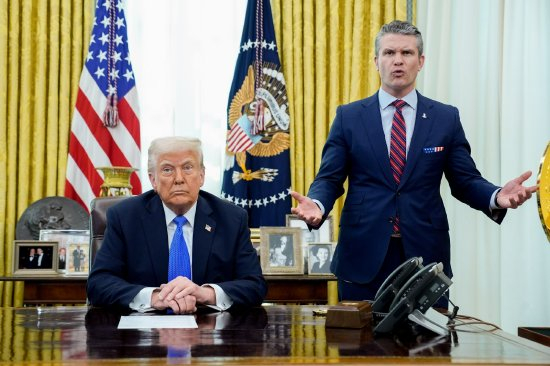
 Since the start of the second Trump administration, the Defense Department under Secretary Hegseth has deliberately and systematically weakened the protections meant to ensure compliance with international humanitarian law. This includes removing senior military lawyers without publicly citing misconduct, and replacing the Army, Navy, and Air Force judge advocates general, directly undermining legal oversight of combat operations. It has also abolished “civilian environment teams” and other mechanisms specifically designed to limit harm to civilians during operations. The 2026 National Defense Strategy omits references to civilian protection and international law entirely. These changes are especially concerning in light of Defense Secretary Pete Hegseth’s comments that rules of engagement interfere with “fighting to win.”
We, the undersigned U.S.-based international law experts, professors, and practitioners write to express profound concern about serious violations of international law and alarming rhetoric by the United States, Israel, and Iran in the present armed conflict in the Middle East.
Due to our connection to the United States, our focus here is on the conduct of the U.S. government, but we remain concerned about the risk of atrocities across the region including the continuing risks posed by the Iranian government to Iranians through violent crackdowns on dissent, and to civilians across the Middle East through Iran’s ongoing unlawful strikes on civilian infrastructure using explosive weapons in densely populated areas.
One month has passed since the United States and Israel launched strikes across Iran. The initiation of the campaign was a clear violation of the United Nations Charter, and the conduct of United States forces since, as well as statements made by senior government officials, raise serious concerns about violations of international human rights law and international humanitarian law, including potential war crimes.
We collectively affirm the importance of equal application of international law to all, including countries that hold themselves out as global leaders. Recent statements from senior U.S. government officials describing the rules governing military engagement as “stupid” and prioritizing “lethality” over “legality” are profoundly alarming and dangerously short-sighted. These claims, particularly in combination with the observable conduct of U.S. forces, are harming the international legal order and the system of international law that we have devoted our lives to promoting.
The war, which is costing U.S. taxpayers between $1-2 billion each day, is imposing significant harm to civilians in the region, has resulted in the loss of hundreds of civilian lives across the Middle East, and is causing serious environmental and economic harms.
We write to express our concern about 1) jus ad bellum, or the decision to go to war, 2) jus in bello, or the conduct of hostilities, 3) rhetoric and threats from senior U.S. officials and their allies, which portend further abuses, and 4) the decimation of civilian harm mitigation structures within the U.S. government as a part of U.S. Secretary of Defense Pete Hegseth’s “gloves off” approach to warfare.
We are gravely concerned that the conduct and threats outlined here are causing serious harm to civilians in the Middle East, and that they also contribute to escalating the conflict, damaging the environment and the global economy, and that they risk degrading the rule of law and fundamental norms that protect every nation’s civilians. Public statements by senior officials indicate an alarming disrespect for the rules of international humanitarian law accepted by states, and which protect both civilians and members of the armed forces.
We urge U.S. government officials to uphold the UN Charter, international humanitarian law, and human rights law at all times, and to publicly make clear U.S. commitment to and respect for norms of international law.
We remind all states of their legal obligations not to aid or assist the United States, Israel, or Iran in the commission of internationally wrongful acts, as well as to cooperate to bring to an end through lawful means serious breaches of peremptory norms of general international law (jus cogens) including the prohibition of aggression and the basic rules of international humanitarian law.
We also urge the U.S. governments’ allies and cooperating partners to take steps to respect and ensure respect for international humanitarian law, in line with Common Article 1 of the Geneva Conventions and associated customary international law. The United States has itself acknowledged that states should seek to promote adherence by others to international humanitarian law. The International Committee of the Red Cross 2016 Commentary on the First Geneva Convention of 1949 provides that a state is “in a unique position to influence the behavior” of partner states where the state “participates in the financing, equipping, arming or training of the armed forces of a Party to a conflict, even plans, carries out and debriefs operations jointly with such forces.”