In economics, diminishing returns means the decrease in marginal (incremental) output of a production process as the amount of a single factor of production is incrementally increased, holding all other factors of production equal. The law of diminishing returns states that in a productive process, if a factor of production continues to increase, while holding all other production factors constant, at some point a further incremental unit of input will return a lower amount of output. The law of diminishing returns does not imply a decrease in overall production capabilities; rather, it defines a point on a production curve at which producing an additional unit of output will result in a lower profit. Under diminishing returns, output remains positive, but productivity and efficiency decrease.
The modern understanding of the law adds the dimension of holding other outputs equal, since a given process is understood to be able to produce co-products. An example would be a factory increasing its saleable product, but also increasing its CO2 production, for the same input increase. The law of diminishing returns is a fundamental principle of both micro and macro economics and it plays a central role in production theory.
The concept of diminishing returns can be explained by considering other theories such as the concept of exponential growth. It is commonly understood that growth will not continue to rise exponentially, rather it is subject to different forms of constraints such as limited availability of resources and capitalization which can cause economic stagnation. This example of production holds true to this common understanding as production is subject to the four factors of production which are land, labor, capital and enterprise. These factors have the ability to influence economic growth and can eventually limit or inhibit continuous exponential growth. Therefore, as a result of these constraints the production process will eventually reach a point of maximum yield on the production curve and this is where marginal output will stagnate and move towards zero. Innovation in the form of technological advances or managerial progress can minimize or eliminate diminishing returns to restore productivity and efficiency and to generate profit.
This idea can be understood outside of economics theory, for example, population. The population size on Earth is growing rapidly, but this will not continue forever (exponentially). Constraints such as resources will see the population growth stagnate at some point and begin to decline. Similarly, it will begin to decline towards zero but not actually become a negative value, the same idea as in the diminishing rate of return inevitable to the production process.
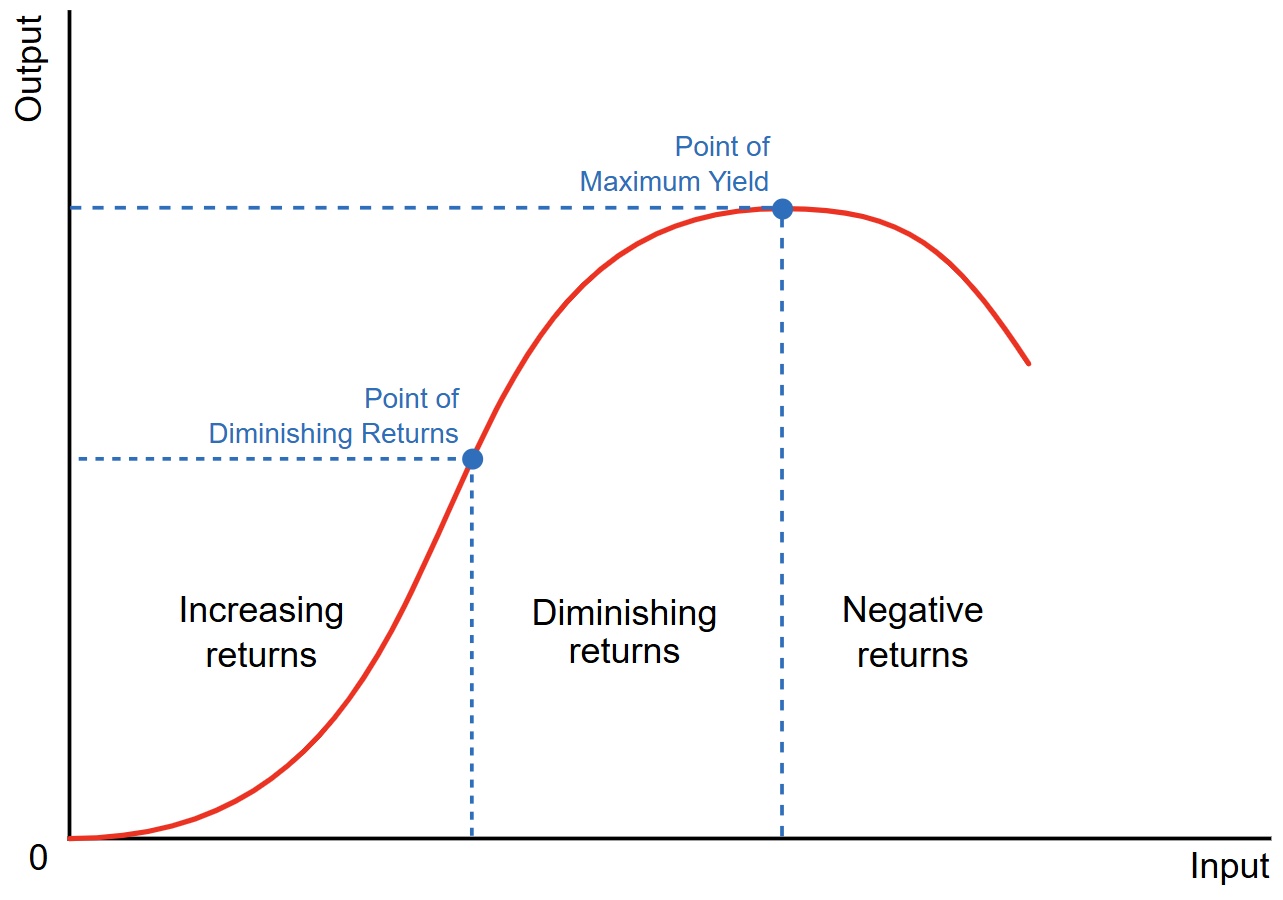
Diminishing returns
https://en.wikipedia.org/wiki/Diminishing_returns
In economics, diminishing returns means the decrease in marginal (incremental) output of a production process as the amount of a single factor of production is incrementally increased, holding all other factors of production equal. The law of diminishing returns states that in a productive process, if a factor of production continues to increase, while holding all other production factors constant, at some point a further incremental unit of input will return a lower amount of output. The law of diminishing returns does not imply a decrease in overall production capabilities; rather, it defines a point on a production curve at which producing an additional unit of output will result in a lower profit. Under diminishing returns, output remains positive, but productivity and efficiency decrease.
The modern understanding of the law adds the dimension of holding other outputs equal, since a given process is understood to be able to produce co-products. An example would be a factory increasing its saleable product, but also increasing its CO2 production, for the same input increase. The law of diminishing returns is a fundamental principle of both micro and macro economics and it plays a central role in production theory.
The concept of diminishing returns can be explained by considering other theories such as the concept of exponential growth. It is commonly understood that growth will not continue to rise exponentially, rather it is subject to different forms of constraints such as limited availability of resources and capitalization which can cause economic stagnation. This example of production holds true to this common understanding as production is subject to the four factors of production which are land, labor, capital and enterprise. These factors have the ability to influence economic growth and can eventually limit or inhibit continuous exponential growth. Therefore, as a result of these constraints the production process will eventually reach a point of maximum yield on the production curve and this is where marginal output will stagnate and move towards zero. Innovation in the form of technological advances or managerial progress can minimize or eliminate diminishing returns to restore productivity and efficiency and to generate profit.
This idea can be understood outside of economics theory, for example, population. The population size on Earth is growing rapidly, but this will not continue forever (exponentially). Constraints such as resources will see the population growth stagnate at some point and begin to decline. Similarly, it will begin to decline towards zero but not actually become a negative value, the same idea as in the diminishing rate of return inevitable to the production process.
**
収穫逓減
https://ja.wikipedia.org/wiki/収穫逓減
収穫逓減は、経済学用語であり、収穫逓減の法則とも呼ばれる。
固定および可変の入力(例えば工場規模と労働者数)のある生産システムで、可変入力がある点を過ぎると、入力の増加が出力の増加に結びつかなくなっていく。逆に製品をより多く生産するのにかかるコストは増大していく。
表面上は完全に経済的概念だが、収穫逓減はテクノロジ的関係も暗示している。収穫逓減の法則は、企業の短期限界費用曲線が結局は増大することを示している。
AIバブルはこうして終わる 金利高と収穫逓減「死の交差」
by 永井洋一
https://www.nikkei.com/article/DGXZQOUB164ZN0W6A910C2000000/
米国のアンソロピックやオープンAIが人工知能(AI)開発の減速を呼びかけるのは暴走への歯止めだけが理由ではないはずだ。いずれAIが資本を食い潰してしまうディストピアが脳裏をよぎるからだろう。
AI産業は難問に直面している。追加投資に比べ追加収益はそれほど大きくならないという「収穫逓減の法則」だ。先人が、農地にまく肥料を増やしても思うほど収穫量は増えないとして頭を抱えた古くて新しい問題といえる。