France is subject to the EU’s excessive deficit procedure, with the bloc recommending the country bring its national deficit closer to a reference value of 3%. Last year, France’s deficit reached 5.1% of GDP.
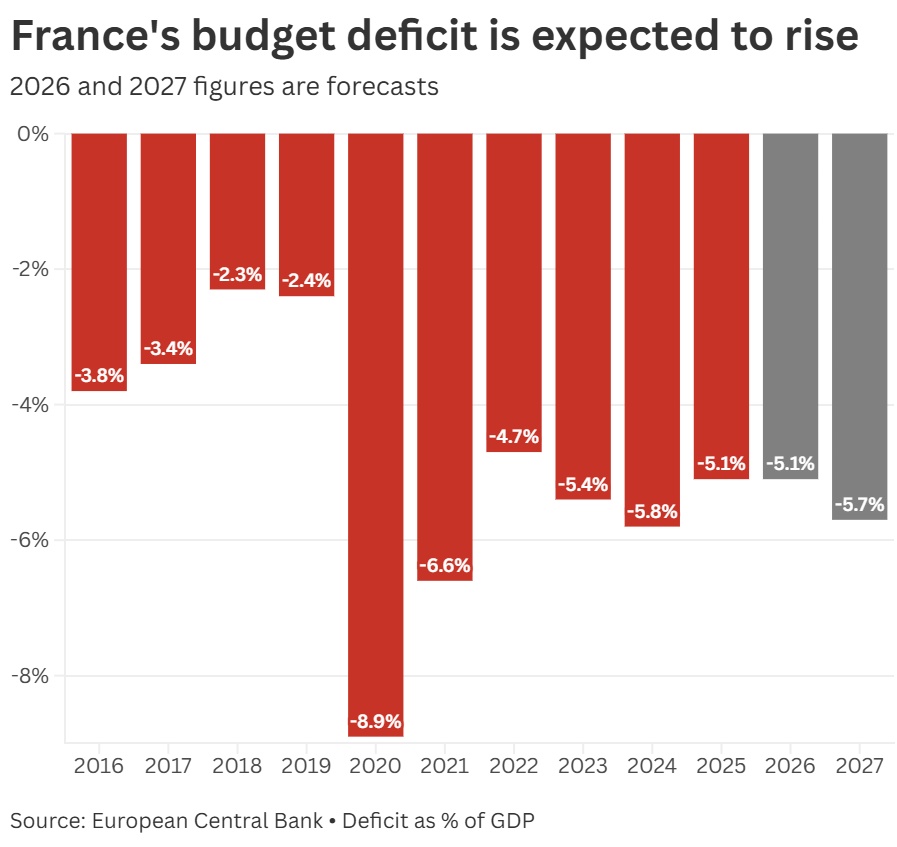
France is subject to the EU’s excessive deficit procedure, with the bloc recommending the country bring its national deficit closer to a reference value of 3%. Last year, France’s deficit reached 5.1% of GDP.
‘Get your house in order’: IMF chief’s stark warning for France over surging bond yields
by Chloe Taylor, CNBC
https://www.cnbc.com/2026/10/07/imf-france-debt-student-protests-yields.html
The head of the International Monetary Fund had a blunt message to the French government in a CNBC interview on Wednesday: bring your finances under control.
France is currently in the throes of another political crisis, with violent student protests now stretching into their third week.
The movement – which has seen young people across the country demonstrate discontent with long study days, teacher shortages and rundown schools – comes as the French government seeks to win over a politically fractured parliament and convince lawmakers to agree to tens of billions of euros worth of spending cuts.
Political instability in France has put pressure on the country’s government bonds, known as OATs. Investors now demand a higher yield than they do for bonds issued by the Italian government, with French 10-year bond yields
rising by more than 100 basis points since the start of the year.
“What we see in France is a complication of, on one side, the consequence of borrowing shock after shock after shock, climbing on this staircase that does not lead to heaven, and on the other side, a political dynamic scene in France that creates more difficulties for the finance ministry to put a clear path for tightening,” IMF Managing Director Kristalina Georgieva told CNBC’s Lisa Kim on the sidelines of an event in Singapore.
She noted that there is a “very clear recognition in France that deficit needs to be brought under 5%.”
France is subject to the EU’s excessive deficit procedure, with the bloc recommending the country bring its national deficit closer to a reference value of 3%. Last year, France’s deficit reached 5.1% of GDP.
But when asked if the current situation in the French bond market echoed the euro zone sovereign debt crisis of the early 2000s, Georgieva suggested Europe was better protected now.
“The French economy is growing,” she said. “And I think we need to remember that, [compared] to the previous time, we have a much more mature system in Europe. We have the strength of the European Central Bank. We have other instruments that Europe has developed to protect against financial stability risks.”
But she added: “Yet again, my message is — get your house in order.”
Asked whether the multi-billion-euro fiscal adjustment being proposed by the French government would be more difficult now against the backdrop of the student protests, Georgieva conceded that “it’s going to be tough, no question about it.”
She noted that since the Covid-19 pandemic, populations had become accustomed to governments “running to the rescue” of people and businesses when a shock occurs.
“As difficult as it is, there has to be active communication to explain to people why getting to a better place is actually in their interest, and I think we need more voices to speak about it, not only from government but also from trade unions, from the business community, to bring people together on a mission to improve the prospects for better economic future,” she said.
“Bond markets respond to fundamentals, and the fundamentals have changed,” she added. “Inflation is up, interest rates are up, government debt is high. Bond markets are looking for signal that the government borrowing is going to be contained, and we are encouraging governments please send the signal because otherwise we may we may see further climbs up.”
フランスが戦争に巻き込まれれば、現在すでに脆弱な財政は「かなり深刻なダメージ」を受ける可能性が高いです。 これは感情的な予測ではなく、IMFが2026年に示したフランス財政の現状から論理的に導ける結論です。
◆ 1. フランス財政は「高債務・高赤字・低成長」という弱い基盤にある
IMFの2026年報告によれば、フランスは以下の構造的問題を抱えています:
IMFは「高債務・低成長・支出圧力の中で、財政の持続性がリスクにさらされている」と警告しています。 つまり、平時ですら財政余力が乏しい状態です。
◆ 2. すでに“遠い戦争”の影響でフランス経済は揺らいでいる
IMFは2026年報告で、
これは、フランスが直接戦争に参加していないにもかかわらず起きている現象です。
つまり、「遠い戦争」でさえフランス経済は揺らぐということです。
◆ 3. もしフランスが“直接”戦争に巻き込まれたら何が起きるか
これはIMF報告の内容を踏まえた合理的な推論です。
● (1) 財政赤字の急拡大
戦争は必ず以下の支出を増やします:
フランスはすでに赤字が大きいため、追加支出はそのまま財政悪化に直結します。
● (2) 国債利回りの上昇
EU内で財政規律が問題化し、 フランス国債のリスクプレミアムが上昇する可能性があります。
ユーロ圏は自国通貨を発行できないため、 日本のように「国債を中央銀行が買い支える」ことができません。
● (3) 成長率のさらなる低下
IMFはすでに「外部ショックで成長率が0.6%まで低下」と述べています。 戦争が直接フランスに及べば、
が重なり、成長率はゼロ近く、あるいはマイナスに落ち込む可能性があります。
● (4) EU内での財政問題化
フランスはEUの中核国であり、 財政悪化はユーロ圏全体の金融不安につながります。
◆ 4. 東日本大震災のように「財政が耐える」可能性は低い
日本は自国通貨を発行できるため、 危機時には日銀が国債を買い支えることができます。
しかしフランスはユーロ圏であり、 自国通貨発行という“最後の安全弁”がありません。
そのため、
◆ 5. 結論
フランスが戦争に巻き込まれれば、財政はかなり深刻なダメージを受ける。 IMFが示す現在の財政状況(高債務・高赤字・低成長)を踏まえると、 東日本大震災のように「財政が持ちこたえる」可能性は低い。